Corporate Governance
- Company Profile
- Company Structure
- Board of Directors
- Board Committees
- Corporate Policies
- Corporate Governance
- Shareholder Meeting Resolutions
- Internal Audit
- Investor FAQs
| Company Name | GlobalWafers Co., Ltd. |
|---|---|
| Stock Name | GWC |
| Stock Code | 6488 |
| Market Type | OTC-Listed |
| Industry Type | Semiconductor |
| Principal Activities | Research, develop and design on semiconductor ingots/wafers |
| Date of Establishment | 2011-10-18 |
| Date of Listing | 2015-09-25 |
| Capital | NT$ 4,352,370,000 |
| Chairman | Doris Hsu |
| Principal Office | No. 8. Industrial East Road 2. Science-Based Industrial Park, Hsinchu, Taiwan, R.O.C. |
| Number of Employees | |
| Stock Transfer Agent | Yuanta Securities Co.,Ltd Registrar & Transfer Agency Dept. |
| Auditors | KPMG |
| Bankers | . |
| Legal Advisors | . |
| Tel | +886-3-577-2255 |
| Fax | +886-3-578-1706 / +886-3-579-0405 |
| GWCIR@sas-globalwafers.com | |
| Website | www.sas-globalwafers.com |
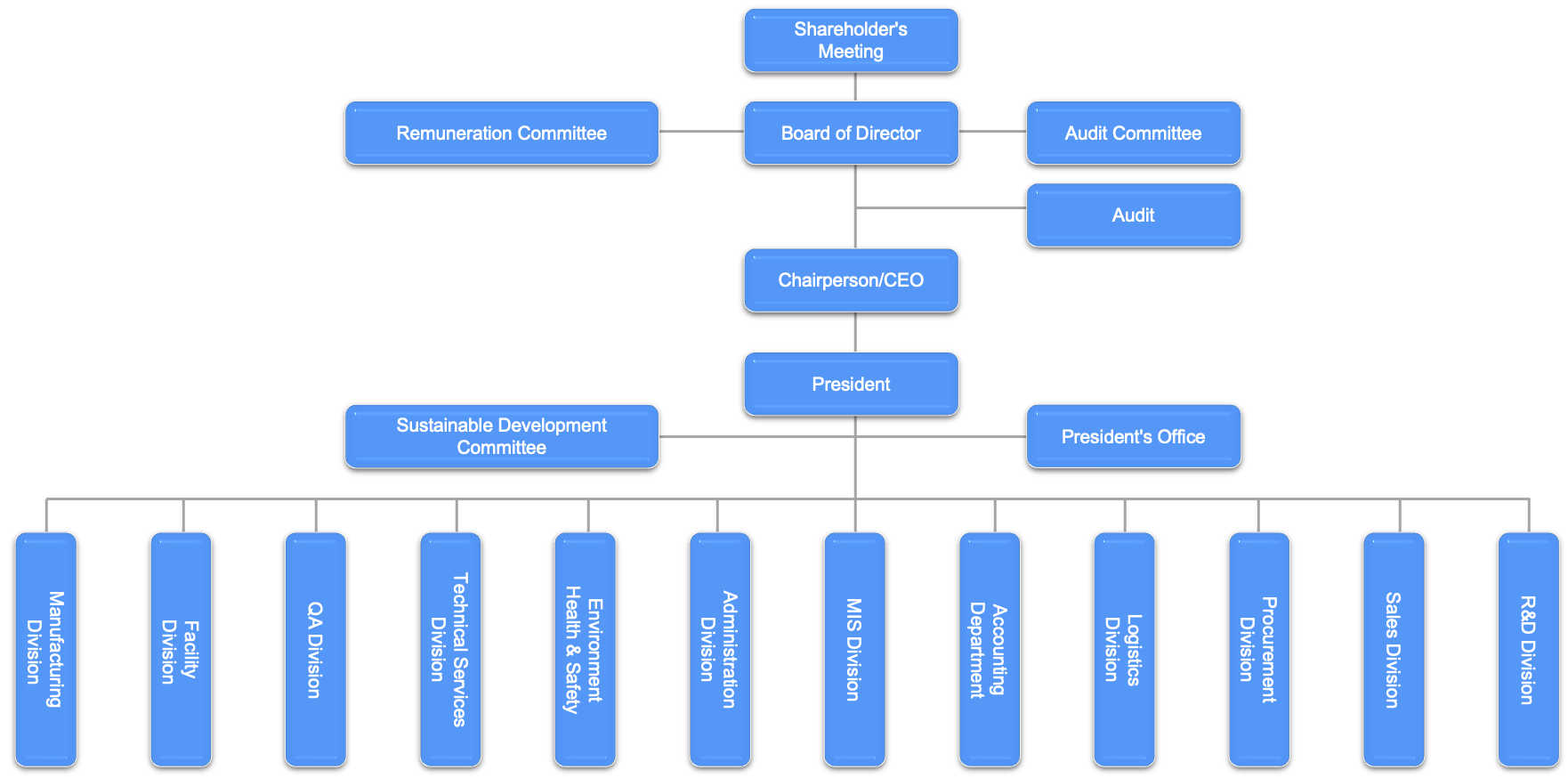
| Title | Name | Responsibilities |
|---|---|---|
| Chairperson | Hsiu-Lan Hsu (Miss) | |
| President | Mark England (Mister) | |
| R&D VP | Wen-ching Hsu (Mister) | |
| Manufacturing VP | Wen-ching Hsu (Mister) | |
| Logistics VP | Wei-Wen Chen (Mister) | |
| Procurement VP | Wei-Wen Chen (Mister) | |
| Corporate Development VP | Chung-Wei Lee (Mister) | |
| Sales VP | Sheng-Hsiung Hung (Mister) | |
| CFO | Ming-Hui Chien (Mister) | |
| Accounting Manager | Yu-Ting Lo (Miss) | |
| President of Taisil Branch | Yin-Sheng Shueh (Mister) | |
| R&D Vice President of Taisil Branch | Liang-Chin Chen (Mister) | |
| QA/Product Integration Vice President of Taisil Branch | Yao-Yi Huang (Mister) | |
| Production Vice President of Taisil Branch | Chun-Jung Huang (Mister) | |
| Projects Vice President of Taisil Branch | Chun-Wei Huang (Mister) |
Information on the Selection of Directors
Diversity Policy for the Board Members
The composition of the board of directors has taken diversity into consideration and formulating an appropriate policy on diversity based on the company’s business operations, operating dynamics, and development needs. It is advisable that the policy include the following two general standards:
- Basic requirements and values: Gender, age, nationality, and culture
- Professional knowledge and skills: A professional background (e.g., law, accounting, industry, finance, marketing, technology), professional skills, and industry experience
All members of the board shall have the knowledge, skills, and experience necessary to perform their duties. To achieve the ideal goal of corporate governance, the board of directors shall possess the following abilities:
- Ability to make operational judgment
- Ability to perform accounting and financial analysis
- Ability to conduct management administration
- Ability to conduct crisis management
- Knowledge of the industry
- An international market perspective
- Ability to lead
- Ability to make policy decisions
| POSITION | NAME | MAJOR EDUCATION | WORK EXPERIENCE |
|---|---|---|---|
| Chairperson & CEO | Doris Hsu (Hsiu-Lan Hsu) | Master degree in Computer Science, University of Illinois | Executive vice president of Sino-American Silicon Products Inc. |
| Sino-American Silicon Products Inc. Representative Director | Ming-Kuang Lu | Honorary doctorate of Science in National Chiao Tung University | President of Lite-On Semiconductor Corp. President of Vishay Lite-On Power Semiconductor Corp., Vice President of Silitek Corp |
| Sino-American Silicon Products Inc. Representative Director | Tan-Liang Yao | MBA degree, Tamkang University | Assistant vice president at Lite-On Semiconductor Corp. President of Sino American Silicon Products Inc. |
| Director | Kuo-Chow Chen | Nan Ying Vocation High School | Chairman of Nan‐Hai Optoelectronics Technology Co. Ltd. Director of COTA Commercial Bank |
| Independent Director | Jeng-Ywan Jeng | Ph. D. in Engineering of the University of Liverpool | President, College of Engineer, National Taiwan University of Science and Technology Distinguished Professor, Department of Mechanical Enginering, National Taiwan University of Science and Technology |
| Independent Director | Chung-Yu Wang | Advanced Management Program, Harvard University | Director of CX Technology Corporation Director of Curiemed Corporation |
| Independent Director | Ming-Ren Yu | MBA from New York University | Vice President of Elite Material Co., Ltd. |
| Independent Director | Ta-Hsien Lo | Ph. D. in Management of Technology, National Chiao Tung University | Chairperson, Chinese Professional Management Association Distinguished Expert, Industrial Technology Research Institute Adjunct Professor, College of Technology Management, National Tsing Hua University |
Performance Evaluation of Board of Directors
Title
Download
Evaluation of CPA Independence (Chinese version)
Title
Download
- Audit Committee
The Audit Committee helps to supervise the following items:
- Appropriate description of the financial report of the company
- New appointment, conge, qualification, independence and credit of CPA
- Effective implementation of the internal control
- Abidance of relevant laws and regulations
- Existing and potential risks management
- Committee list
| Name |
|---|
| Jeng-Ywan Jeng (Independent director) |
| Chung-Yu Wang (Independent director) |
| Ming-Ren Yu (Independent director) |
| Ta-Hsien Lo (Independent director) |
Communication among Internal and External Auditors
Title
Download

Remuneration Committee
Title
Download
- Remuneration Committee
The Remuneration Committee helps the Board to execute and evaluate overall remuneration and welfare policies, as well as remunerations of directors and managers.
Three independent directors constitute Remuneration Committee and convene at least two meetings a year.
- Committee list
| Name |
|---|
| Jeng-Ywan Jeng (Independent director) |
| Chung-Yu Wang (Independent director) |
| Ming-Ren Yu (Independent director) |
| Ta-Hsien Lo (Independent director) |
Nominating Committee
Title
Download
- Nominating Committee
With authorization from the board of directors (below, “the board”), the Nominating Committee shall consist of at least three directors elected by the board, which more than half of whom shall be independent directors, and exercise the due care of a good administrator to faithfully perform the following duties and shall submit its proposals to the board for discussion:
- Finding, evaluating and nominating candidates for directors and senior executives based on standards of independence and a diversified background covering the expertise, skills, experience, gender, etc.
- Establishing and developing the organizational structure of the board and each committee, and evaluating the performance of the board, each committee and each director as well as the independence of the independent directors.
- Establishing and reviewing programs for director continuing education and the succession plans of directors and senior executives.
- Executing other resolutions that the board assigns.
Chairperson , Hsiu-lan Hsu, is the convenor of the Nominating Committee and has expertise in management, mergers and acquisitions, and corporate governance. As the result, she is in line with the professional capabilities required by the Committee.
- Committee list
| Name | Title |
|---|---|
| Hsiu-lan Hsu | Chairperson |
| Jeng-Ywan Jeng (Independent director) | Member |
| Ming-Ren Yu (Independent director) | Member |
- Sustainability Development Committee
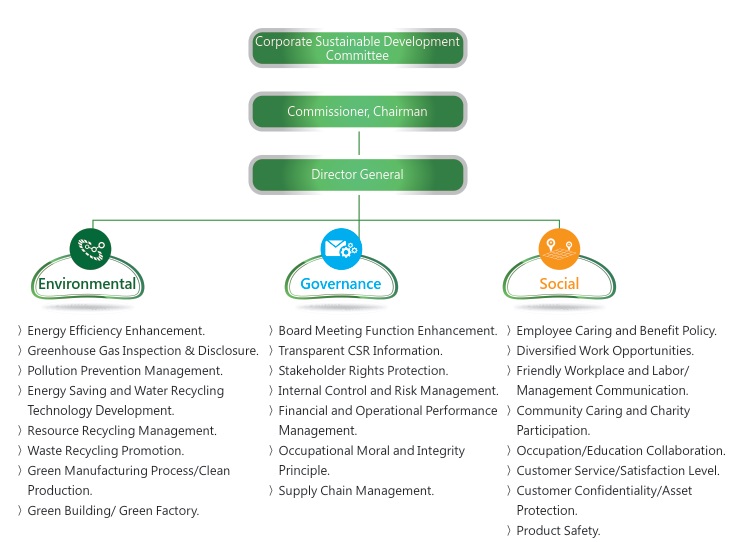
The Company has established the Corporate Sustainability Development Committee in June 2017, the highest-level sustainable development decision-making center within the Company. It is responsible for coordinating and comprehensively managing all aspects of the Company’s development directions and goal formulation related to ESG (environmental, social, and governance) sustainable development in all aspects, to pursue the sustainable development and fulfill social responsibilities.
The Company’s Corporate Sustainability Development Committee is chaired by the Chairperson, the Corporate Governance Officer is the director general, and representatives from each functional organization are designated to serve the members. Through the cross-function integration, the ESG-related goals, policies and development strategies are formulated, the implementation programs are promoted, and the implementation effectiveness is reviewed and improved continuously; the regular annual meeting of all members are convened every year, to review the achievement of the relevant goals for the previous year, and set the goals for the coming year.
The Corporate Sustainability Committee is supervised by the board of directors. In addition to the annual report by the chair to the board of directors on the implementation of sustainable development and the achievement of goals, it also reports performance indicators and related data on environmental issues to the board of directors every quarter. The board of directors supervises the goal-setting for sustainable development and reviews the implementation, while giving relevant advices and guidance based on the content of the report.
Company Policies
Title
Download
GWC follows Corporate Governance Best-Practice Principles for TSEC/GTSM Listed Companies, by which to
- protect shareholders’ rights and interests;
- strengthen the powers of the board of directors;
- fulfill the function of audit committee;
- respect stakeholders’ rights and interests; and
- enhance information transparency.
Based on Regulations for the Establishment of Internal Control Systems by Public Companies, GWC takes into consideration the overall operational activities of itself and its subsidiaries in establishing an effective internal control system, and review it at all times, in order to keep up with the dynamics of environment inside and outside the company and ensure that the design and enforcement of the system remain effective.
The board of directors and the management shall review the result of the self-inspection of each department and the report of the internal audit department at least annually. Members of the audit committee shall also pay attention to and exercise oversight of this matter.
GWC executives pay special attention to the internal audit department and its personnel, fully empower them and urge them to conduct audits effectively, evaluate problems of the internal control system and assess the efficiency of operations to ensure that such a system can be carried out effectively on a continuous basis and can assist the board of directors and the management to perform their duties effectively so as to ensure a sound corporate governance system.
1. Board of Directors
The number of the board members has been properly determined by reviewing the scale of corporate management and operation and the shareholding of the major shareholders and taking into consideration of the practical needs for operation. While installing independent directors, it shall take into account the reasonable professional composition of the directors and the objective requirements for their duties independently. Clear distinctions have been drawn between the responsibilities and duties of the chairman of the board and those of the president. Positions have been fulfilled by different executives.
2. Audit Committee
GlobalWafers has set up the audit committee. members of the audit committee can communicate with GlobalWafers’ employees, shareholder and related person through the board meeting, shareholder meeting and audit reports, among other channels.
Chief Corporate Governance Officer
GlobalWafers’ Chief Finance Office (who has more than three years of experience in finance, stock affairs and deliberations of the public company) is assigned to be the Chief Corporate Governance Officer, and shall be responsible for leading and supervising the President’s Office in the handling of corporate governance-related matters and providing support to directors, and the terms of reference include:
1. Handling matters related to meetings of the Board of Directors and shareholders’ meetings in accordance with the law.
2. Producing minutes of the board of directors and shareholders’ meetings.
3. To assist the Directors in their appointment and ongoing education.
4. Providing the information required by the directors to carry out their business.
5. To assist directors in complying with the ordinance.
6. To report to the board of directors the results of its inspection on whether the qualifications of independent directors comply with relevant laws and regulations at the time of nomination, election and term of office.
7. Handle matters related to the change of directors.
8. Other matters as stipulated in the Articles of Incorporation of the company.
Status of Continue Education Implementation by Chief Corporate Governance Officer
Title
Download
Sustainable Development Best Practice Principles :
Status of Promotion of Sustainable Development
Title
Download
Ethical Corporate Management Best Practice Principles :
Status of Ethical Corporate Management Implementation
Title
Download
Statues of Other Corporate Governance Implementation
Title
Download
Shareholder Meeting Resolutions
Title
Download
Rules and Procedures of Shareholders’ Meeting
- Article 1
Unless otherwise provided for in applicable laws and regulation, Shareholders’ Meeting of the Company (the “Meeting”) shall be conducted in accordance with these Rules and Procedures. - Article 2
The votes at a shareholders’ meeting may be exercised in either written or electronic format in accordance with the Company Law and related regulations. Shareholders (hereinafter referred to as the representative or proxy appointed by shareholders) who attend the Meeting shall hand in an attendance card at the meeting in lieu of signing in and shall be regarded as the ones(shareholders or deputy persons) who attend the Meeting in person. The Company will not take the responsibility of identification. - Article 3
The attendance and voting shall be calculated in accordance with the shares. - Article 4
The Meeting shall be held at the head office of the Company or at any other appropriate place that is convenient for the shareholders to attend. The time to start the Meeting shall not be earlier than 9:00 a.m. or later than 3:00 p.m. - Article 5
The Meeting shall be convened by the Board of Directors (“BOD”) and the Chairperson of BOD shall be the Chairperson presiding at the Meeting. If the Chairperson of BOD cannot preside at the Meeting for any reason, the Vice Chairperson of BOD shall preside at the Meeting. If the Company does not have Vice Chairperson of the BOD or the Vice Chairperson of the BOD cannot fulfill his/her duty for any reason, the Chairperson of the BOD shall appoint a deputy person. If the Chairperson of BOD does not appoint a deputy person, the Directors shall elect one Director as the deputy person. If the Meeting is convened by any other person entitled to convene the Meeting, such person shall be the Chairperson to preside at the Meeting. - Article 6
The Company may appoint designated counsel, CPA or other related persons to attend the Meeting. Persons handling affairs of the Meeting shall wear identification cards or badges. - Article 7
The process of the Meeting shall be tape recorded or videotaped and these tapes shall be preserved for at least one year. - Article 8
Chairperson shall call the Meeting to order at the time scheduled for the Meeting. If the number of shares represented by the shareholders present at the Meeting has not yet constituted the quorum at the time scheduled for the Meeting, the Chairperson may postpone the time for the Meeting. The postponements shall be limited to two times at the most and Meeting shall not be postponed for longer than one hour in the aggregate. If after two postponements no quorum can yet be constituted but the shareholders present at the Meeting represent more than one-third of the total outstanding shares, tentative resolutions may be made in accordance with Paragraph 1 of Article 175 of the Company Law. If the quorum is constituted during the process of the Meeting, the Chairperson may submit the aforesaid tentative resolution to the Meeting for approval in accordance with Article 174 of the Company law. - Article 9
The agenda of the Meeting shall be set by the Board of Directors if the Meeting is convened by the Board of Directors. Unless otherwise resolved at the Meeting, the Meeting shall proceed in accordance with the agenda. The provision above applies mutatis mutandis to cases where the Meeting is convened by any person, other than the Board of Directors, entitled to convene such Meeting. Unless otherwise resolved at the Meeting, the Chairperson cannot announce adjournment of the Meeting before all the discussion items (including special motions) listed in the agenda are resolved. The shareholders cannot designate any other person as Chairperson and continue the Meeting in the same or other place after the Meeting is adjourned. However, in the event that the Chairperson adjourns the Meeting in violation of these Rules and Procedures, the shareholders may designate, by a majority of votes represented by shareholders attending the Meeting, one person as Chairperson to continue the Meeting. - Article 10
When a shareholder (or deputy person) presents at the Meeting wishes to speak, a Speech Note should be filled out with summary of the speech, the shareholder’s number (or the number of Attendance Card) and the name of the shareholder. The sequence of speeches by shareholders should be decided by the Chairperson. If any shareholder (or deputy person) present at the Meeting submits a Speech Note but does not speak, no speech should be deemed to have been made by such shareholder. In case the contents of the speech of a shareholder are inconsistent with the contents of the Speech Note, the contents of actual speech shall prevail. Unless otherwise permitted by the Chairperson and the shareholder in speaking, no shareholder shall interrupt the speeches of the other shareholders; otherwise the Chairperson shall stop such interruption. - Article 11
Unless otherwise permitted by the Chairperson, each shareholder shall not, for each discussion item, speak more than two times (each time not exceeding 5 minutes). In case the speech of any shareholder violates the above provision or exceeds the scope of the discussion item, the Chairperson may stop the speech of such shareholder. - Article 12
Any legal entity designated as proxy by a shareholder(s) to be present at the Meeting may appoint only one representative to attend the Meeting. If a corporate shareholder designates two or more representatives to attend the Meeting, only one representative can speak for each discussion item. - Article 13
After the speech of a shareholder, the Chairperson may respond himself/herself or appoint an appropriate person to respond. - Article 14
The Chairperson may announce to end the discussion of any resolution and go into voting if the Chairperson deems it appropriate. - Article 15
Except otherwise specified in the Company Law, a resolution shall be adopted by a majority of the votes represented by the shareholders present at the Meeting. If no objection is voiced after solicitation by the Chairperson, the resolution shall be deemed adopted and shall have the same effect as if it was voted. The person(s) to check and the person(s) to record the ballots during a vote shall be appointed by the Chairperson. The person(s) checking the ballots shall be a shareholder. The result of voting shall be announced at the Meeting and placed on record. - Article 16
During the Meeting, the Chairperson may, at his discretion, set time for intermission. - Article 17
Except otherwise specified in the Article of Incorporation of the Company, a resolution shall be adopted by a majority of the votes represented by the shareholders present at the Meeting. - Article 18
If there is amendment to or substitute for a discussion item, the Chairperson shall decide the sequence of voting for such discussion item, the amendment or the substitute. If any one of them has been adopted, the others shall be deemed vetoed and no further voting is necessary. - Article 19
The Chairperson may conduct the disciplinary officers (or the security guard)to assist in keeping order of the Meeting place. Such disciplinary officers (or security guards) shall wear badges marked “Disciplinary Officers” for identification purpose. - Article 20
Matters not covered by these rules shall be handled in accordance with the provisions of the law. - Article 21
These Rules and Procedures shall be effective from the date it is approved by the Shareholders’ Meeting. The same applies in case of revision. - Article 22
The Rules and Procedures were enacted on June 27, 2012.
The Purpose of Internal Audit
The purpose of Internal Audit is to assist the Board of Directors and top management to enhance the effectiveness and efficiency of the company’s operations, to assure the company’s profit, performance, and property, to compliance with applicable laws and regulations, by providing timely suggestions to assure the effective execution of internal control system.
Internal Audit Organization
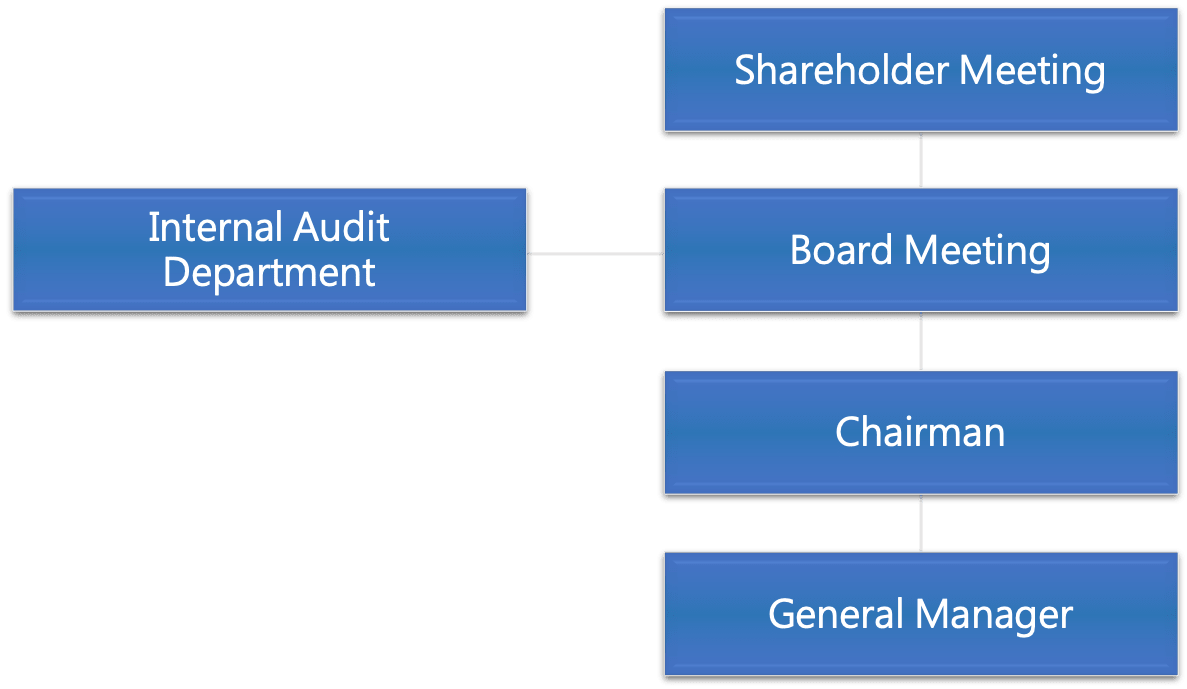
Internal Audit is under the board of directors. Any appointment or discharge of internal audit manager shall be approved by the Board of Directors. The appointment, removal, salary, remuneration, evaluation, reward and punishment of internal auditors shall be signed by the audit director and approved by the Chairperson of the Board in accordance with the provisions of the Company’s “Delegation of Authority”. There is one audit supervisor in the current configuration as well as several auditors.
Internal Audit Implementation
Internal auditors shall formulate annual audit plans based on the results of the risk assessment, including matters to be audited monthly, by which to check its internal control systems, and compile audit reports with annexing working papers and relevant materials. Annual internal audit plan and any amendment shall be approved by the Board of Directors. Independent directors have been set up in the Company. Annual audit plan shall be submitted to Board of Directors in accordance with the rules and opinions of each
independent director shall be given full consideration. Regularly audit in accordance with internal auditing schedule, and make auditing reports after each audit to be attached with relevant documents, and present shortcomings and improvement recommendations and continue to track improvement actions.
Internal auditors shall faithfully disclose in audit reports any defects and irregularities of the internal control systems discovered in inspection and, after having presented the reports, follow up on the matters and prepare follow-up reports on a regular basis to ensure that the relevant departments have taken appropriate corrective measures in a timely manner.
Internal auditors shall be detached, independent, objective, and impartial, in faithfully performing their duties, and in addition to reporting their audit operations to each supervisor on a regular basis, the internal audit officer shall also attend and deliver a report to a Board of Directors’ meeting.
The company and its subsidiaries shall prescribe the content of and procedures for self-audits and assessments of the internal control system, which is conducted at least once every year. Annual self-inspections of its internal control systems shall be first conducted periodically by all internal departments and subsidiaries themselves and reports shall be reviewed by internal auditors.
Corrections of any defects and irregularities of the internal control system discovered shall be the guidance for Board of Directors and President to evaluate the effectiveness and announce Internal Control System Statement. Self-inspections report and relevant materials shall be kept at least five years.
The Company shall announce the following matters in the prescribed format via the internet-based information system before the deadline designated by Financial Supervisory Commission.
- Next year’s audit plan by the end of each fiscal year shall be submitted before the end of each fiscal year.
- Previous year’s internal auditor’s basic information together with their training hours received shall be submitted within one month from the end of each fiscal year
- The execution of previous year’s annual audit plan shall be submitted within two months from the end of each fiscal year
- Previous year’s Internal Control System Statement shall be submitted within four months from the end of each fiscal year
- Corrections of previous year’s any defects and irregularities of the internal control system discovered shall be submitted within four months from the end of each fiscal year
Q: When was GWC established and when were GWC shares listed?
A: Date of establishing: 2011-10-18
Data of listing: 2015-09-25
Q: Where can you find more financial information related to GWC?
A: The information is available at the Financial Releases section
Q: What is the GWC stock code on the GreTai Securities Market?
A: GWC's stock is coded 6488.
Q: What is the number of GWC’s outstanding shares?
A: The information is available at the http://mops.twse.com.tw/
Q: What is GWC's historical dividend pay out?
A: The information is available at the Shareholder Services section
Q: Where can you find GWC historical stock price information?
A: For more stock price information, please visit http://www.tpex.org.tw/web/ or the Stock Quote section
Q: What is status of GWC’s shareholders?
A: The information is available at http://mops.twse.com.tw/